Shape-informed graph neural networks and data assimilation: application to velocity and pressure reconstruction in aortic blood flow
Apr 1, 2026· ,,,,·
0 min read
,,,,·
0 min read
Francesco Romor
Felipe Galarce
Jan Brüning
Leonid Goubergrits
Alfonso Caiazzo
Abstract
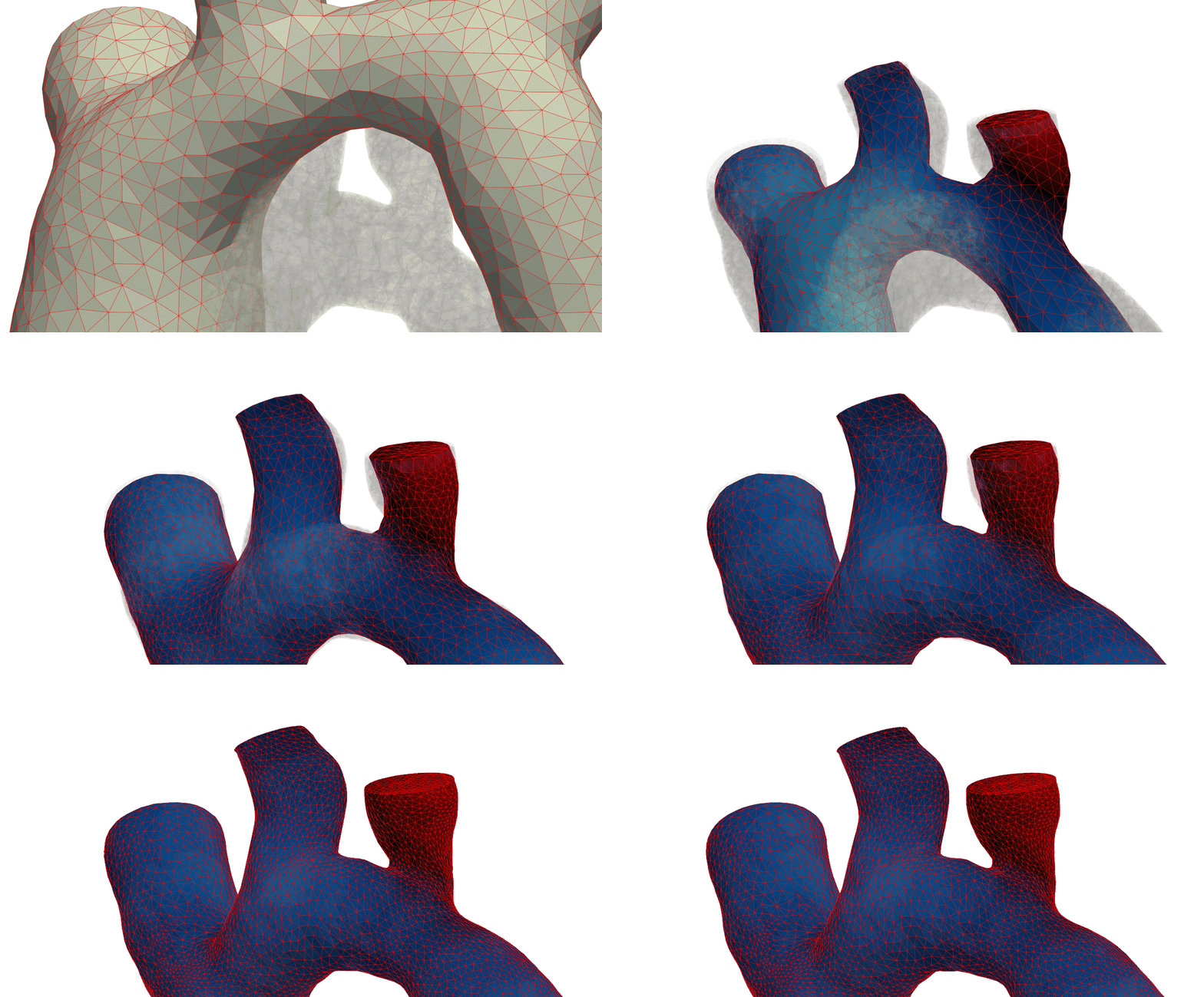
Image-based, patient-specific modelling of hemodynamics can improve diagnostic capabilities and provide complementary insights to better understand the hemodynamic treatment outcomes. However, computational fluid dynamics simulations remain relatively costly in a clinical context. Moreover, projection-based reduced-order models and purely data-driven surrogate models struggle due to the high variability of anatomical shapes in a population. A possible solution is shape registration: a reference template geometry is designed from a cohort of available geometries, which can then be diffeomorphically mapped onto it. This provides a natural encoding that can be exploited by machine learning architectures and, at the same time, a reference computational domain in which efficient dimension-reduction strategies can be performed. We compare state-of-the-art graph neural network models with recent data assimilation strategies for the prediction of physical quantities and clinically relevant biomarkers in the context of aortic coarctation.
Type
Publication
SIAM journal on Imaging Sciences